
By Darwin Palma, Lead Data Engineer at Vizorfin
Let me start with a confession: I’ve built production systems on spreadsheets. I’ve also spent years migrating organizations off them. I understand why spreadsheets persist in fund operations — they’re flexible, familiar, and require no procurement cycle.
But there’s a difference between “spreadsheets work” and “spreadsheets are the right tool.” This article is a technical comparison, not a sales pitch. I’ll be direct about where spreadsheets are fine and where they create structural risk.
The Case for Spreadsheets (Yes, Really)
Spreadsheets are not the enemy. In fund operations, they’re genuinely useful for:
- Ad-hoc analysis where the structure isn’t known in advance
- Small-scale operations with a single fund and low transaction volume
- Prototyping workflows before formalizing them
- One-off calculations that don’t need to be repeated
If your fund operations fit these categories, a spreadsheet may be sufficient. The problems begin when spreadsheets become the system of record.
Where Spreadsheets Break Down
1. Data integrity at scale
A spreadsheet is only as reliable as the last person who edited it. As fund operations grow, the number of manual edits increases, and so does the risk of inconsistency. There’s no built-in validation, no referential integrity, and no audit trail of who changed what.
2. Compliance traceability
Regulators expect data lineage. When a compliance report is filed, you should be able to trace any figure back to its source. In a spreadsheet-based process, that traceability is often reconstructed after the fact — if it’s possible at all.
3. Concurrent access
Multiple people editing the same spreadsheet is a known failure mode. Version conflicts, overwritten formulas, and silent data corruption are common. Purpose-built platforms handle concurrent access as a core design requirement.
4. Scaling with fund count
A spreadsheet model that works for one fund often requires a separate workbook for each additional fund. This creates duplication, increases maintenance overhead, and makes cross-fund reporting difficult.
5. Key-person dependency
Spreadsheet-based operations tend to concentrate knowledge in specific individuals. If that person leaves, the workflow leaves with them.
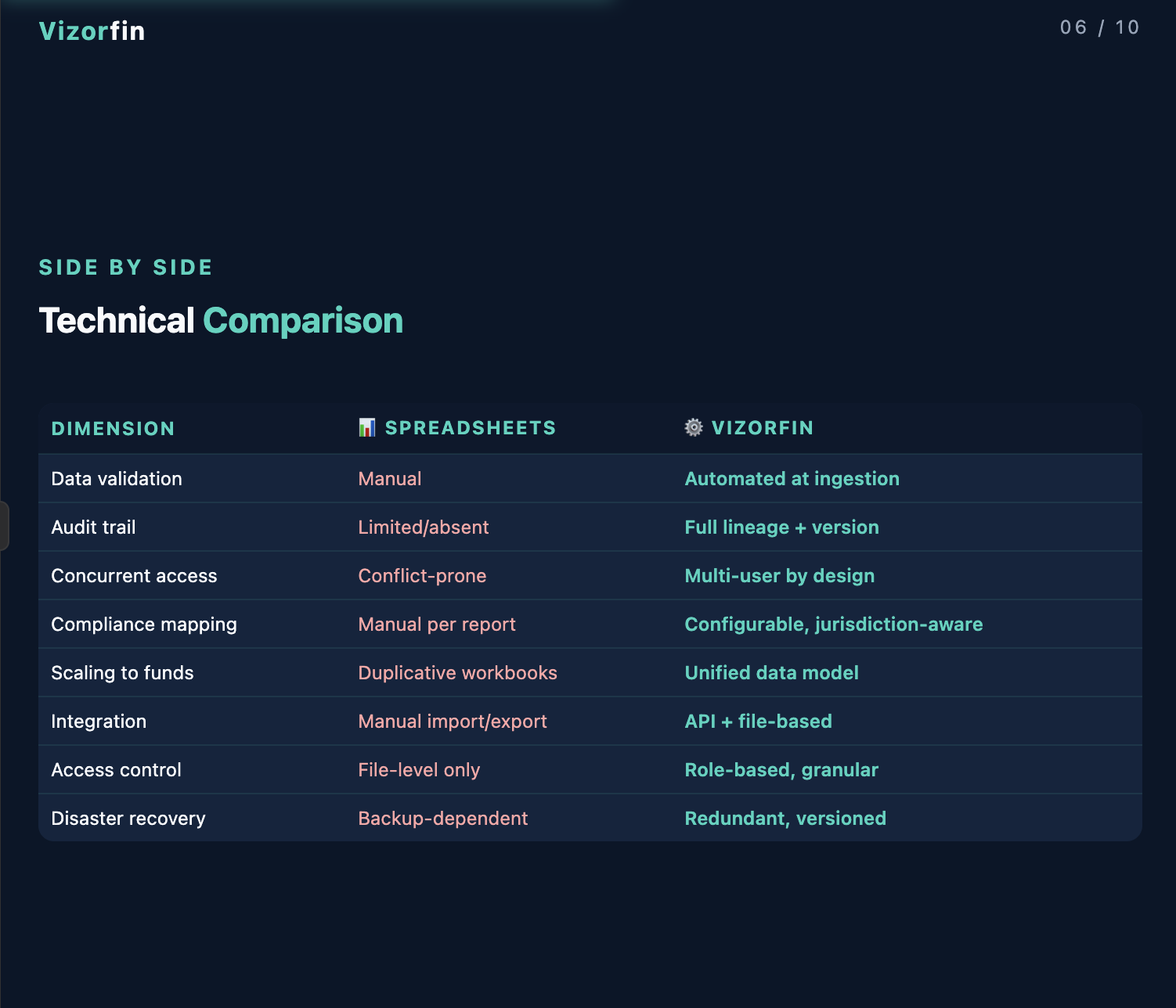
Technical Comparison: Spreadsheets vs. Purpose-Built Platforms
| Dimension | Spreadsheets | Purpose-Built Fund Operations Software |
|---|---|---|
| Data validation | Manual, error-prone | Automated at ingestion |
| Audit trail | Limited or absent | Full lineage and version history |
| Concurrent access | Conflict-prone | Designed for multi-user access |
| Compliance mapping | Manual, per-report | Configurable, jurisdiction-aware |
| Scaling to multiple funds | Duplicative workbooks | Unified data model |
| Integration | Manual import/export | API and file-based integrations |
| Access control | File-level only | Role-based, granular |
| Disaster recovery | Dependent on backups | Redundant, versioned |
A Note on AI and Automation Claims
You’ll see many vendors in 2026 claiming “AI-powered” fund operations. It’s worth being precise about what that means.
AI can help with:
- Anomaly detection in incoming data
- Pattern recognition across historical reports
- Natural language querying of operational data
AI cannot:
- Replace regulatory judgment
- Guarantee compliance outcomes
- Eliminate the need for human review
Any platform that blurs these lines should be evaluated carefully.
Where Vizorfin Fits
Vizorfin is an AI-powered platform for corporate financial management. Our architecture is built around automated data ingestion, validation, and configurable compliance workflows for fund operations.
I’m not going to claim Vizorfin is right for every fund. It’s not. If you’re running a single small fund with low transaction volume, a well-maintained spreadsheet may be sufficient.
Where Vizorfin is designed to help is in operations where:
- Multiple funds need consistent reporting
- Compliance requirements span multiple jurisdictions
- Data comes from multiple custodians and administrators
- Manual reconciliation is consuming significant team time
Important: Vizorfin is a financial technology company. We are not a registered investment adviser, broker-dealer, or financial services licensee in any jurisdiction. Our software is a decision-support tool and should not be the sole basis for financial or compliance decisions. Individual results will vary based on your specific circumstances, data environment, and implementation. You should consult with qualified financial, legal, and tax professionals regarding your specific situation.
Risk Warning: The use of AI-powered financial automation tools involves risks. No specific financial outcome is guaranteed. You should not rely solely on automated systems for financial decision-making.
If you’d like to see how VizorFin handles fund data ingestion and compliance workflows,
This content is for educational and informational purposes only and does not constitute financial, investment, legal, or tax advice.