
By Darwin Palma, Lead Data Engineer at Vizorfin
Migration projects fail for predictable reasons. Not because the technology is wrong, but because the transition isn’t planned around how the team actually works.
I’ve led data migrations in regulated environments. Here’s how I’d approach migrating fund operations — from spreadsheets or legacy systems — with minimal disruption.
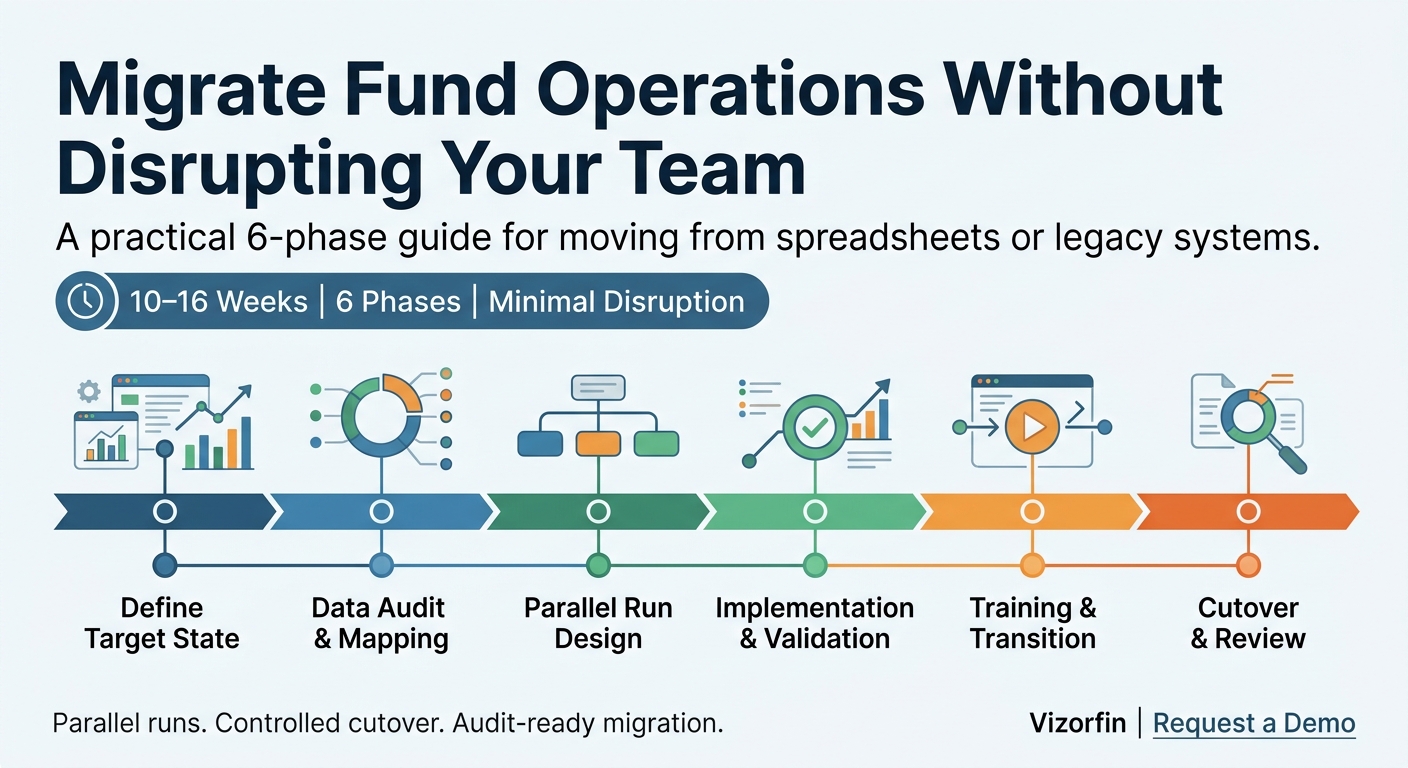
Phase 1: Define the Target State (Weeks 1–2)
Before touching any system, define what “done” looks like.
Questions to answer:
- Which fund operations will be managed in the new platform?
- Which data sources will feed into it?
- Which reports will be generated from it?
- Which compliance workflows will run through it?
- What stays outside the platform (and why)?
Write this down. Migration scope creep is the most common cause of delays.
Phase 2: Data Audit and Mapping (Weeks 2–4)
This is the phase most teams underestimate.
What to do:
- Inventory every data source (custodians, administrators, internal systems)
- Document file formats, delivery schedules, and field definitions
- Identify which fields are used in which reports
- Flag any data quality issues that need resolution before migration
Deliverable: A data mapping document that traces each report field back to its source.
This document becomes the foundation for both implementation and future audits.
Phase 3: Parallel Run Design (Weeks 4–6)
The safest migration runs in parallel with existing processes for at least one full reporting cycle.
Design considerations:
- Which reports will be generated in both systems?
- How will discrepancies be investigated?
- Who signs off on the parallel run results?
- What’s the exit criteria for switching to the new system?
Parallel runs add short-term workload, but they dramatically reduce the risk of a failed cutover.
Phase 4: Implementation and Validation (Weeks 6–10)
This is where the platform is configured, integrations are built, and reports are generated.
Key activities:
- Configure data ingestion for each source
- Set up validation rules at ingestion
- Map compliance requirements to data fields
- Build report templates
- Configure access controls and audit logging
Validation approach:
- Run historical data through the new system and compare outputs
- Test exception handling workflows
- Verify audit trail completeness
Phase 5: Team Training and Transition (Weeks 10–12)
Technology migration is also a process migration. Your team’s workflows will change.
Training should cover:
- How to review and approve automated outputs
- How to investigate exceptions
- How to generate ad-hoc reports
- How to escalate issues
Transition considerations:
- Identify power users who can support others
- Document new workflows and update internal procedures
- Define a support escalation path with the vendor
Phase 6: Cutover and Post-Migration Review (Weeks 12–14)
Once parallel run results match expectations and the team is trained, cut over.
Post-migration:
- Monitor for issues in the first full reporting cycle
- Review any discrepancies or exceptions
- Collect feedback from the team
- Document lessons learned for future phases
Realistic Timeline Expectations
A typical implementation timeline for a mid-sized fund operation ranges from 10 to 16 weeks, depending on:
- Number of data sources
- Number of funds
- Complexity of compliance requirements
- Internal resource availability
- Whether parallel runs are required
Vendors who promise 2-week implementations for complex fund operations should be evaluated carefully.
Common Migration Mistakes
1. Underestimating data quality work
Legacy data is often inconsistent. Budget time for cleanup.
2. Skipping parallel runs
The short-term workload is worth the risk reduction.
3. Treating it as an IT project only
Operations and compliance teams must be involved from day one.
4. Not defining exit criteria
Without clear criteria, parallel runs can drag on indefinitely.
5. Assuming the vendor handles everything
Vendors provide tooling and support. Internal ownership is still required.
A Note on What Migration Doesn’t Fix
Migrating to a new platform doesn’t fix unclear processes. If your current workflows are undocumented and inconsistent, migrating them to a new system will simply make the inconsistency faster.
Use the migration as an opportunity to document and standardize processes.
Where Vizorfin Fits
Vizorfin provides implementation support for fund operations migration, including data mapping, parallel run design, and training. Our platform is built around automated data ingestion and configurable compliance workflows.
Important: Vizorfin is a financial technology company. We are not a registered investment adviser, broker-dealer, or financial services licensee in any jurisdiction. Our software is a decision-support tool and should not be the sole basis for financial or compliance decisions. Individual results will vary based on your specific circumstances, data environment, and implementation. You should consult with qualified financial, legal, and tax professionals regarding your specific situation.
Risk Warning: The use of AI-powered financial automation tools involves risks. No specific financial outcome is guaranteed. You should not rely solely on automated systems for financial decision-making.
If you’d like to discuss what a migration might look like for your fund operations.
This content is for educational and informational purposes only and does not constitute financial, investment, legal, or tax advice.