
By Darwin Palma, Lead Data Engineer at Vizorfin
Every year, the same pattern plays out inside fund operations teams.
January arrives. Someone opens the compliance calendar. The deadlines are scattered across five jurisdictions, three regulators, and dozens of forms. Every filing has different data requirements, different formats, and different lead times.
The result is predictable: a scramble every quarter, a fire drill every year-end, and a team that spends more time chasing deadlines than managing risk.
This is not a regulatory problem. It’s a data problem.
Why Deadlines Feel Overwhelming
The complexity isn’t the deadlines themselves. It’s the fact that each deadline requires data from multiple sources — custodians, administrators, internal systems — to be reconciled, validated, and transformed into a specific format.
If that data pipeline is manual, every deadline becomes a project. If it’s automated, deadlines become routine events.
A Snapshot of the 2026 Landscape
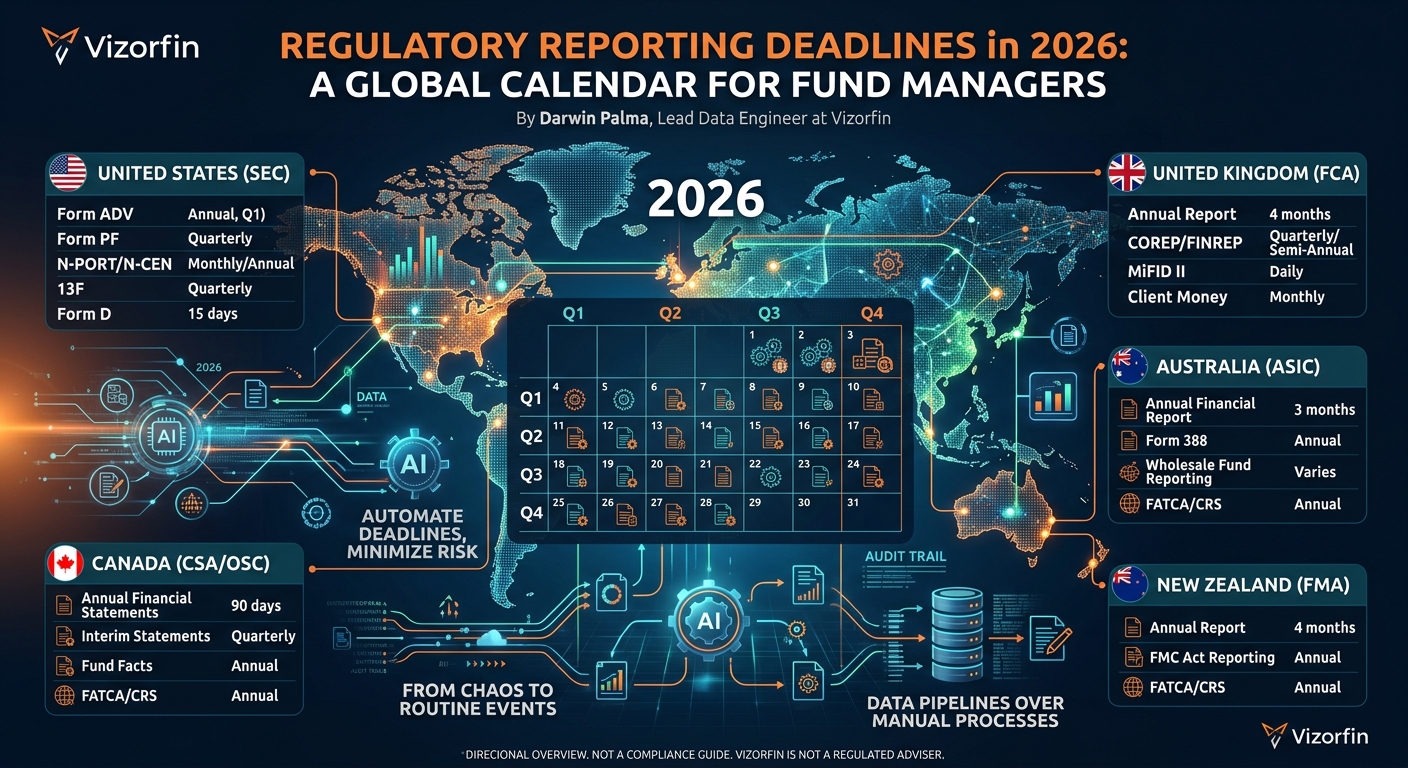
Below is a high-level view of the major recurring deadlines fund managers face across the five jurisdictions most relevant to English-speaking markets.
🇺🇸 United States (SEC)
- Form ADV: Annual amendment within 90 days of fiscal year-end
- Form PF: Quarterly (large hedge funds), annually (others)
- N-PORT / N-CEN: Monthly and annual filings for registered funds
- 13F: Quarterly within 45 days of quarter-end
- Form D: Within 15 days of first sale
🇬🇧 United Kingdom (FCA)
- Annual Report: Within 4 months of fiscal year-end
- COREP / FINREP: Quarterly and semi-annual
- MiFID II Transaction Reporting: Daily (T+1)
- Client Money Reporting: Monthly
🇦🇺 Australia (ASIC)
- Annual Financial Report: Within 3 months of year-end
- Form 388: Annual
- Wholesale Fund Reporting: Varies by structure
- FATCA / CRS: Annual
🇨🇦 Canada (CSA / OSC)
- Annual Financial Statements: Within 90 days of year-end
- Interim Financial Statements: Within 45 days of quarter-end
- Fund Facts Updates: Annual
- FATCA / CRS: Annual
🇳🇿 New Zealand (FMA)
- Annual Report: Within 4 months of balance date
- FMC Act Reporting: Annual
- FATCA / CRS: Annual
Note: Deadlines vary by fund structure, jurisdiction of domicile, and regulator. This is a directional overview, not a compliance guide.
The Technical Problem Behind the Deadlines
Here’s what most fund operations teams don’t say out loud:
Every deadline requires a data pipeline. And most of those pipelines are manual.
That means:
- Data is pulled manually from multiple systems
- Reconciliation happens in spreadsheets
- Validation is done by visual inspection
- Reports are built by copying and pasting
- Audit trails are reconstructed after the fact
When you multiply this by 20+ deadlines per year across multiple funds and jurisdictions, the operational load becomes unsustainable.
What Changes When Reporting Is Automated
When compliance reporting is automated:
- Data is ingested and validated continuously, not at deadline time
- Reports are generated from a single source of truth
- Exceptions are flagged early, not discovered at the last minute
- Audit trails are built automatically with every data movement
- New deadlines or jurisdictions can be added without rebuilding workflows
The goal is not to eliminate compliance work. It’s to eliminate the manual data movement that surrounds it.
A Practical Starting Point
If your team spends more than one week per quarter preparing for regulatory filings, it’s worth evaluating whether a data pipeline could absorb most of that work.
The questions to ask:
- How many systems does data pass through before it reaches a filing?
- How many people touch that data manually?
- How long does it take to prepare a single quarterly filing?
- What happens when a filing deadline changes or a new jurisdiction is added?
The answers usually point to the same conclusion: the bottleneck is not the regulatory deadline. It’s the operational infrastructure.
Where Vizorfin Fits
Vizorfin builds AI-powered software for corporate financial management, including compliance reporting workflows for fund operations. Our platform is designed to ingest, validate, and transform data into jurisdiction-specific formats.
Important: Vizorfin is a financial technology company. We are not a registered investment adviser, broker-dealer, or financial services licensee in any jurisdiction. Our software is a decision-support tool and should not be the sole basis for financial or compliance decisions. Individual results will vary based on your specific circumstances, data environment, and implementation. You should consult with qualified financial, legal, and tax professionals regarding your specific situation.
Risk Warning: The use of AI-powered financial automation tools involves risks. No specific financial outcome is guaranteed. You should not rely solely on automated systems for financial decision-making.
If you’d like to see how Vizorfin handles multi-jurisdiction reporting workflows.
This content is for educational and informational purposes only and does not constitute financial, investment, legal, or tax advice.