
By Darwin Palma, Lead Data Engineer at Vizorfin
When fund managers talk about compliance breaches, they usually talk about fines.
That’s the visible cost. It’s also the smallest one.
I’ve spent 16 years building data systems in regulated environments. In that time, I’ve observed that the true cost of a compliance breach is rarely captured in any single line item. It’s distributed across operations, reputation, and — most importantly — the data infrastructure that has to be rebuilt after the fact.
Here’s a technical breakdown of what actually happens.
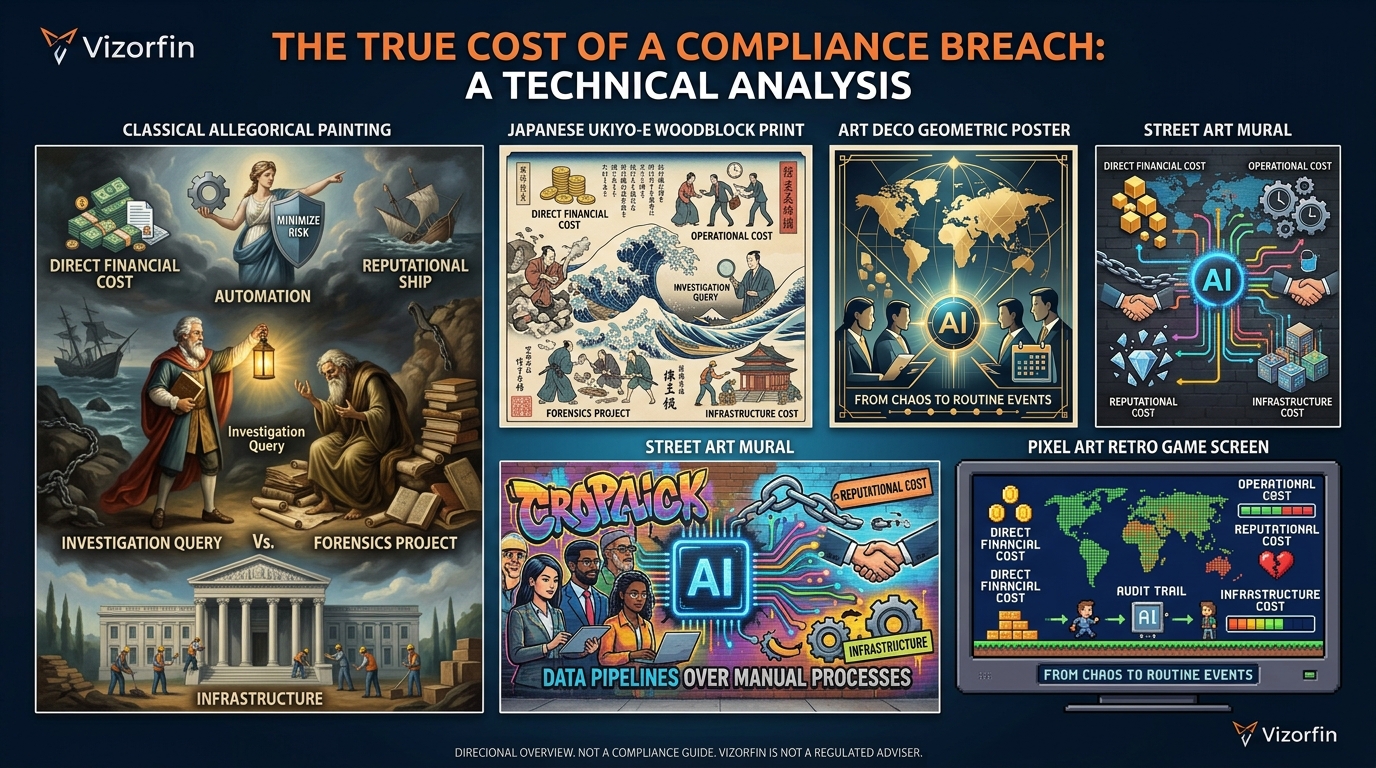
The Four Layers of Cost
1. The Direct Financial Cost
Regulatory fines. Legal fees. Remediation costs. These are the numbers that make headlines. They’re real, and they can be significant. But they’re also the easiest to quantify and the least likely to compound.
2. The Operational Cost
A compliance breach triggers an internal investigation. That investigation consumes operational capacity:
- Operations staff diverted to gather data
- Compliance officers pulled into interviews
- Technology teams building ad-hoc reports
- Executive time spent on regulatory correspondence
This cost is often 3–5x the direct financial cost, and it’s rarely tracked.
3. The Reputational Cost
For fund managers, reputation is the asset. A compliance breach — even one that’s resolved with no fine — can:
- Delay the onboarding of new investors
- Trigger redemption requests from existing investors
- Complicate relationships with custodians and administrators
- Affect the ability to raise future funds
Reputational cost is hard to quantify, but it’s often the largest.
4. The Infrastructure Cost
This is the cost that’s almost never discussed publicly.
After a compliance breach, the data infrastructure that failed has to be rebuilt. That means:
- New data validation layers
- New audit trails
- New reconciliation processes
- New reporting workflows
- New oversight mechanisms
In most cases, the breach exposes weaknesses that were invisible until the failure happened. The rebuild is not optional — regulators expect evidence of remediation.
Why Manual Processes Amplify Breach Costs
Here’s the pattern I’ve observed:
Funds with manual operations recover from compliance breaches slowly. Funds with automated data pipelines recover faster.
The reason is data lineage.
If your operations are manual, reconstructing what happened — which data came from where, who touched it, when it was validated — requires forensic work. In some cases, it’s not fully possible.
If your operations are automated, that lineage is built into the pipeline. The investigation becomes a query, not a project.
What This Means in Practice
If you’re evaluating whether to invest in automating your fund operations, the compliance breach scenario is worth modeling.
Ask yourself:
- If a breach occurred today, how long would it take to reconstruct what happened?
- Could you produce data lineage for every number in a regulatory filing?
- Would the investigation consume weeks or months of operational capacity?
- Would you be able to demonstrate remediation to a regulator in a timely way?
The answers to those questions usually reveal whether your current infrastructure can absorb a breach without cascading consequences.
A Note on Prevention vs. Response
To be clear: automating your data pipelines does not prevent compliance breaches. Breaches can happen for many reasons — judgment errors, regulatory changes, third-party failures.
What automation does is reduce the cost of responding to a breach. It compresses the investigation timeline, produces audit trails automatically, and enables faster remediation.
That’s not a guarantee of safety. It’s a structural advantage when something goes wrong.
Where Vizorfin Fits
Vizorfin builds AI-powered software for corporate financial management, including data lineage and compliance workflows for fund operations. Our architecture is built around traceability — every number in every report is linked to its source.
Important: Vizorfin is a financial technology company. We are not a registered investment adviser, broker-dealer, or financial services licensee in any jurisdiction. Our software is a decision-support tool and should not be the sole basis for financial or compliance decisions. Individual results will vary based on your specific circumstances, data environment, and implementation. You should consult with qualified financial, legal, and tax professionals regarding your specific situation.
Risk Warning: The use of AI-powered financial automation tools involves risks. No specific financial outcome is guaranteed. You should not rely solely on automated systems for financial decision-making.
If you’d like to see how Vizorfin handles data lineage and audit trails.
This content is for educational and informational purposes only and does not constitute financial, investment, legal, or tax advice.