
By Darwin Palma, Lead Data Engineer at Vizorfin
When a fund is small, operational chaos is manageable. The founder knows where the data is. The spreadsheet works. The compliance officer can manually check the numbers.
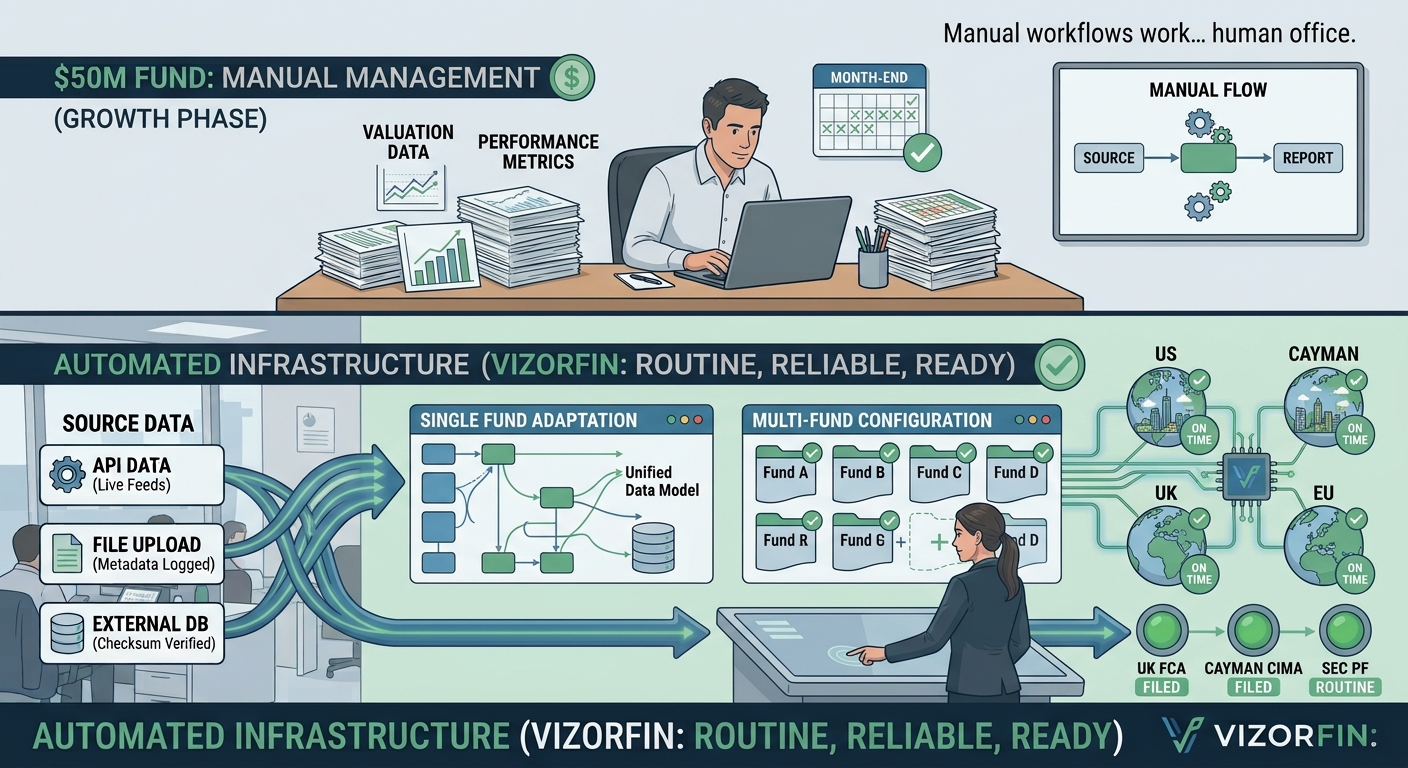
But as a fund grows from $50M to $500M, the infrastructure that got you there is exactly what will hold you back. I’ve seen this pattern repeatedly in my 16 years of building data systems.
Here are the four operational tipping points where manual systems break down—and how to prepare for them before they break.
Tipping Point 1: The “Multi-Custodian” Nightmare
The Scenario: At $50M, you might use one prime broker. At $500M, you likely use three custodians, two administrators, and multiple internal systems.
What Breaks: Manual reconciliation. When you have one data source, a spreadsheet works. When you have five data sources that all format dates differently, use different tickers, and update at different times, manual reconciliation becomes a full-time job that is still prone to error.
The Fix: Automated data ingestion with validation at the source. You need a system that normalizes data from all sources before it hits your reporting layer.
Tipping Point 2: The “New Fund” Drag
The Scenario: You launch a new fund. The strategy is different, but the operational requirements are the same: reconciliation, compliance, NAV calculation, investor reporting.
What Breaks: If your operations are manual, launching a new fund means duplicating all your spreadsheets and workflows. Your operational overhead doesn’t scale linearly; it scales exponentially. Onboarding a new fund can delay operations for weeks.
The Fix: A unified data model. You need an architecture where adding a new fund is a configuration change, not a development project.
Tipping Point 3: The Compliance Complexity Curve
The Scenario: You expand from a US-only fund to a Cayman fund with European investors, managed from the UK.
What Breaks: Jurisdictional compliance. Reporting requirements change. Deadlines differ. Data formats are inconsistent. A manual process that worked for the SEC fails for the FCA and ASIC.
The Fix: A configurable compliance engine. Your data pipeline must map to different regulatory formats without requiring custom code for every new jurisdiction.
Tipping Point 4: The Key-Person Bottleneck
The Scenario: You hire a brilliant Operations Manager who knows the workflows, the formulas, and the manual checks.
What Breaks: If that person leaves, the workflow leaves with them. At $500M, the operational dependency on one person is a material risk to the fund’s continuity.
The Fix: Documented, automated processes. When workflows are codified in a system rather than memorized by a person, institutional knowledge is preserved.
The Operational Readiness Checklist
If you are planning to scale, ask these questions:
- How many manual steps are involved in closing the month?
- How long would it take to onboard a new fund today?
- If your head of operations left tomorrow, how fast could someone else run the reports?
- Can you easily adapt your reporting to a new jurisdiction?
The answers will tell you exactly where your operational ceiling is.
Where Vizorfin Fits
Vizorfin is built for scaling funds. Our architecture is designed so that adding a new fund or a new jurisdiction is a configuration change, not a migration project.
Important: Vizorfin is a financial technology company. We are not a registered investment adviser, broker-dealer, or financial services licensee in any jurisdiction. Our software is a decision-support tool and should not be the sole basis for financial or compliance decisions. Individual results will vary. Consult with qualified financial, legal, and tax professionals.
Risk Warning: The use of AI-powered financial automation tools involves risks. No specific financial outcome is guaranteed. You should not rely solely on automated systems for financial decision-making.
If you’d like to assess your fund’s operational readiness.