
By Darwin Palma, Lead Data Engineer at Vizorfin
Every software vendor wants to sell you “real-time data.” It sounds impressive. It implies speed, agility, and cutting-edge technology.
But in fund management, is real-time data always necessary?
From an engineering perspective, real-time (streaming) architecture is significantly more expensive and complex to build and maintain than batch processing. If you don’t actually need real-time data, buying it is a waste of capital.
Here is how to decide what your fund actually needs.
The Case for Batch Processing
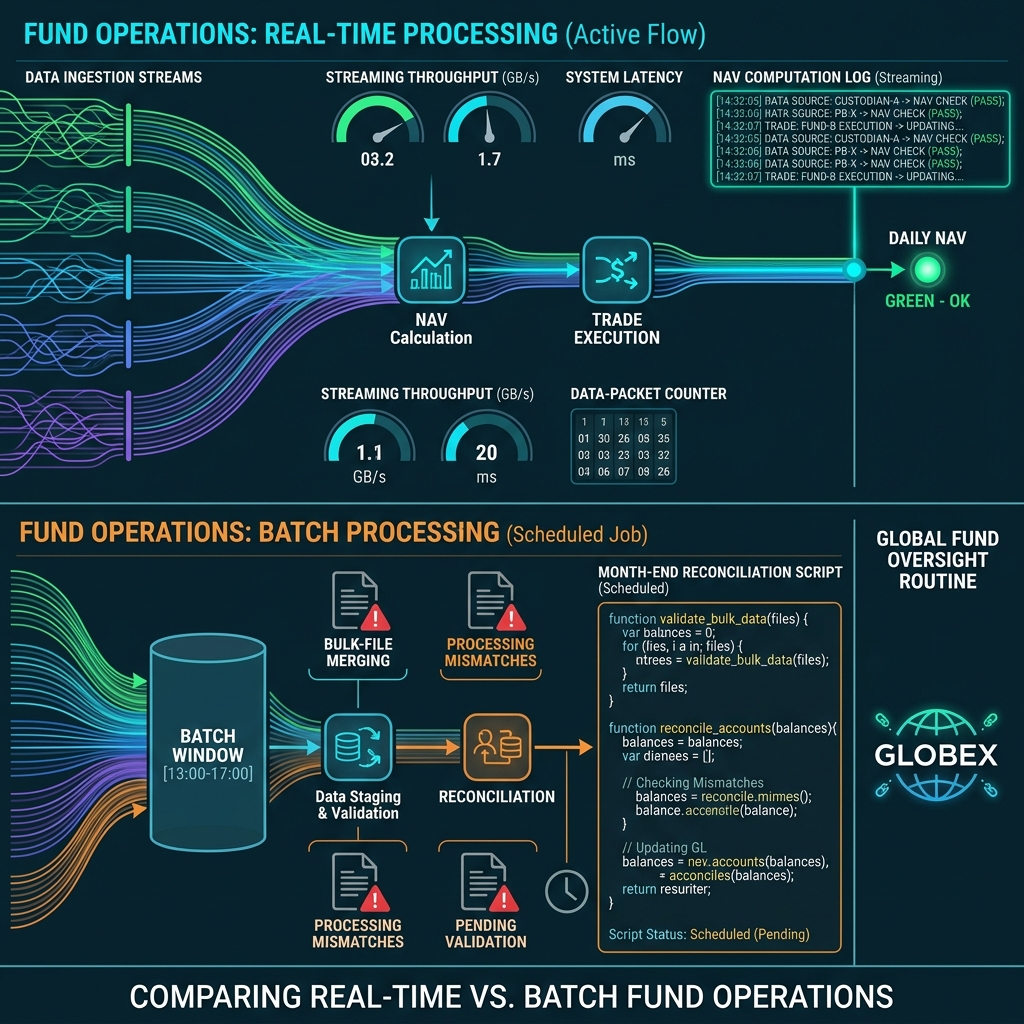
Batch processing involves collecting data over a period (e.g., end of day) and processing it all at once.
When you need it:
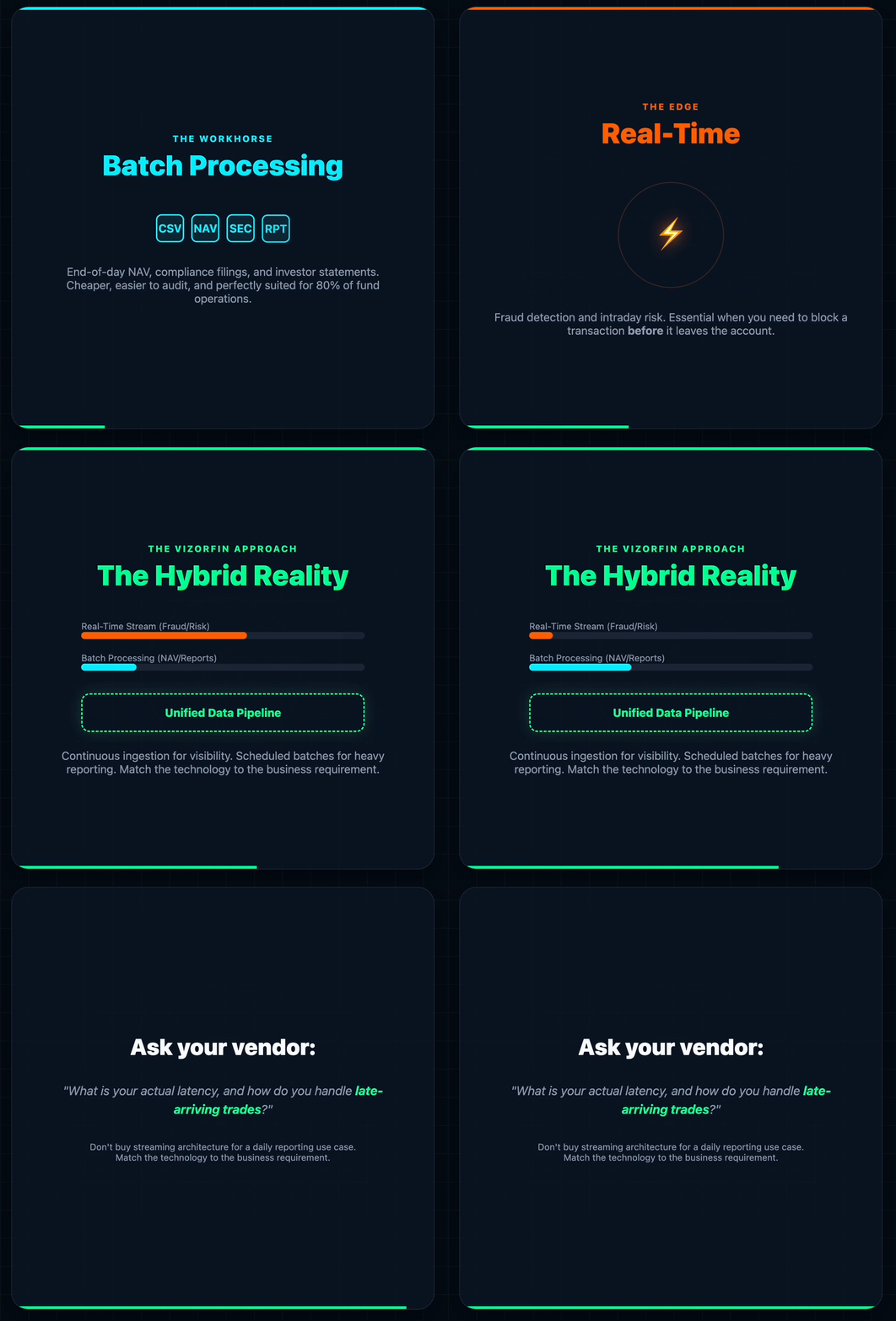
- End-of-Day NAV Calculation: NAV is calculated once a day. You do not need a real-time pipeline for this.
- Regulatory Reporting: Most SEC, FCA, and ASIC reports are filed quarterly, monthly, or annually. A batch process that runs nightly is more than sufficient.
- Investor Statements: Generated at month-end or quarter-end.
The advantage: Batch processing is cheaper, easier to audit (you can verify the entire batch), and perfectly suited for 80% of fund operations.
The Case for Real-Time Processing
Real-time processing involves ingesting and analyzing data continuously as it arrives.
When you need it:
- Fraud Detection: If you need to block a transaction before it leaves the account, you need real-time.
- Intraday Risk Monitoring: If a fund’s strategy requires monitoring margin exposure minute-by-minute to avoid a margin call.
- High-Frequency Trading Data: Ingesting market data feeds for algorithmic trading.
The disadvantage: Real-time pipelines are complex. They require message queues (like Kafka), stream processing engines (like Flink), and robust error handling for late-arriving data. They are expensive to run.
The Hybrid Approach (What Most Funds Actually Need)
The reality is that most funds need a hybrid architecture.
You ingest data continuously (micro-batches) so that your dashboard is updated every 15 minutes or every hour, but you run your heavy compliance reporting and NAV calculations as a scheduled batch process.
You get the benefit of near-real-time visibility without the cost and fragility of a pure streaming architecture.
The Question to Ask Your Vendor
When a vendor tells you their platform is “real-time,” ask them: “What is the actual latency, and how do you handle late-arriving data?”
If they are processing trades, they must have a mechanism to handle a trade that arrives at 4:01 PM but was executed at 3:59 PM. If they just say “we use Kafka,” they don’t understand your business.
Where Vizorfin Fits
Vizorfin uses a hybrid approach. Our agents are designed to process high-priority anomalies (like fraud flags) immediately, while our heavy financial and compliance reporting runs as optimized batch processes. We build for what your fund actually needs, not for the hype.
Important: Vizorfin is a financial technology company. We are not a registered investment adviser, broker-dealer, or financial services licensee in any jurisdiction. Our software is a decision-support tool and should not be the sole basis for financial or compliance decisions. Individual results will vary. Consult with qualified financial, legal, and tax professionals.
Risk Warning: The use of AI-powered financial automation tools involves risks. No specific financial outcome is guaranteed. You should not rely solely on automated systems for financial decision-making.
If you’d like to discuss the right data architecture for your fund.