
By Darwin Palma, Lead Data Engineer at Vizorfin
Every time a new AI tool is announced in the fintech space, the same fear resurfaces: “Is this going to replace my operations team?”
The short answer is no. But the slightly longer answer is that it will fundamentally change what your team actually does.
In fund operations, we often talk about “keeping the human in the loop.” But what does that actually mean? Are we just asking humans to click “Approve” on whatever the AI suggests?
If that’s your model, you don’t have a human in the loop. You have a human rubber-stamping errors.
Here is a technical breakdown of how AI actually shifts the role of the fund operations professional.
The Myth: AI Replaces Judgment
AI cannot replace regulatory judgment. It cannot interpret the intent of a new FCA ruling or decide how to handle a complex NAV discrepancy in a novel market scenario.
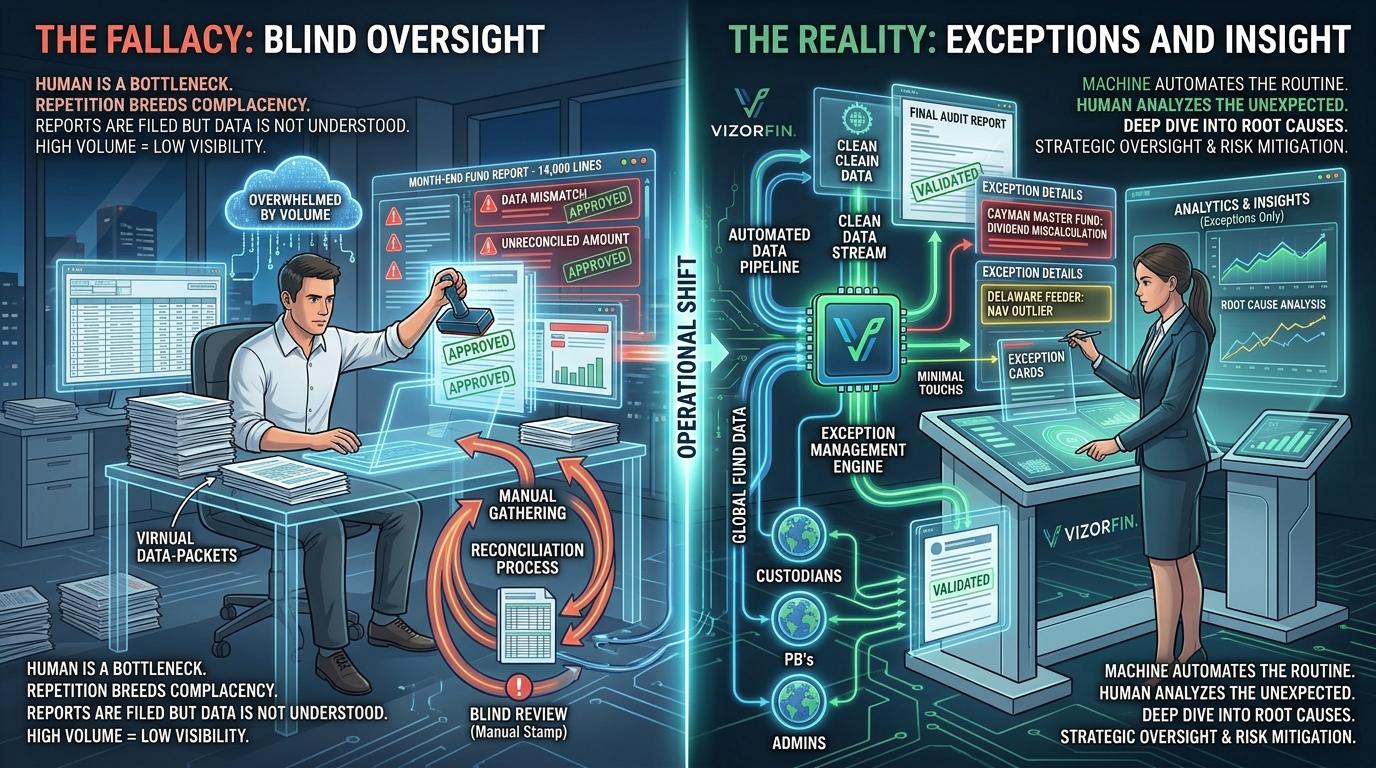
What AI can do is eliminate the manual data movement that currently consumes 80% of your team’s day.
In a manual operation, a fund accountant spends their time:
- Opening CSVs from the custodian.
- Manually matching tickers and dates.
- Spotting discrepancies.
- Copy-pasting data into a reporting template.
In an AI-driven operation, the system ingests the data, normalizes the formats, runs the reconciliation, flags the 2% of exceptions that don’t match, and generates the report.
The fund accountant now spends their time:
- Investigating the 2% of exceptions.
- Determining if the discrepancy is a data error or a legitimate market event.
- Applying regulatory judgment to the resolution.
The shift is from data gathering to data analysis.
The “Rubber Stamp” Trap
The biggest mistake fund managers make when implementing automation is treating the AI as a black box that just outputs a final report.
If your team doesn’t understand how the AI reached its conclusion, they cannot defend it to a regulator. This is where data lineage becomes critical.
A properly designed system doesn’t just give you the answer; it gives you the path to the answer. The “human in the loop” isn’t there to approve the final number. They are there to review the exceptions, validate the logic, and apply professional skepticism where the data is ambiguous.
The New Skill Set
As we move toward 2026, the most valuable skill in fund operations isn’t manual reconciliation speed. It’s the ability to query data, understand exception logic, and spot anomalies that the AI might have missed due to edge-case parameters.
The funds that will scale successfully aren’t the ones that fire their ops team to save money. They are the ones that upskill their ops team from “data processors” to “data managers.”
Where Vizorfin Fits
Vizorfin is built on this philosophy. Our agents automate the heavy lifting—ingestion, validation, and initial reconciliation—so your team can focus on the exceptions that require human judgment. We don’t replace your team; we give them better tools.
Important: Vizorfin is a financial technology company. We are not a registered investment adviser, broker-dealer, or financial services licensee in any jurisdiction. Our software is a decision-support tool and should not be the sole basis for financial or compliance decisions. Individual results will vary. Consult with qualified financial, legal, and tax professionals.
Risk Warning: The use of AI-powered financial automation tools involves risks. No specific financial outcome is guaranteed. You should not rely solely on automated systems for financial decision-making.
If you’d like to see how we structure exception-based workflows.